THE VILLAGE THAT WAS MILAM
Today, Milam is remembered mostly through its ruins. But the stones tell only the last chapter.
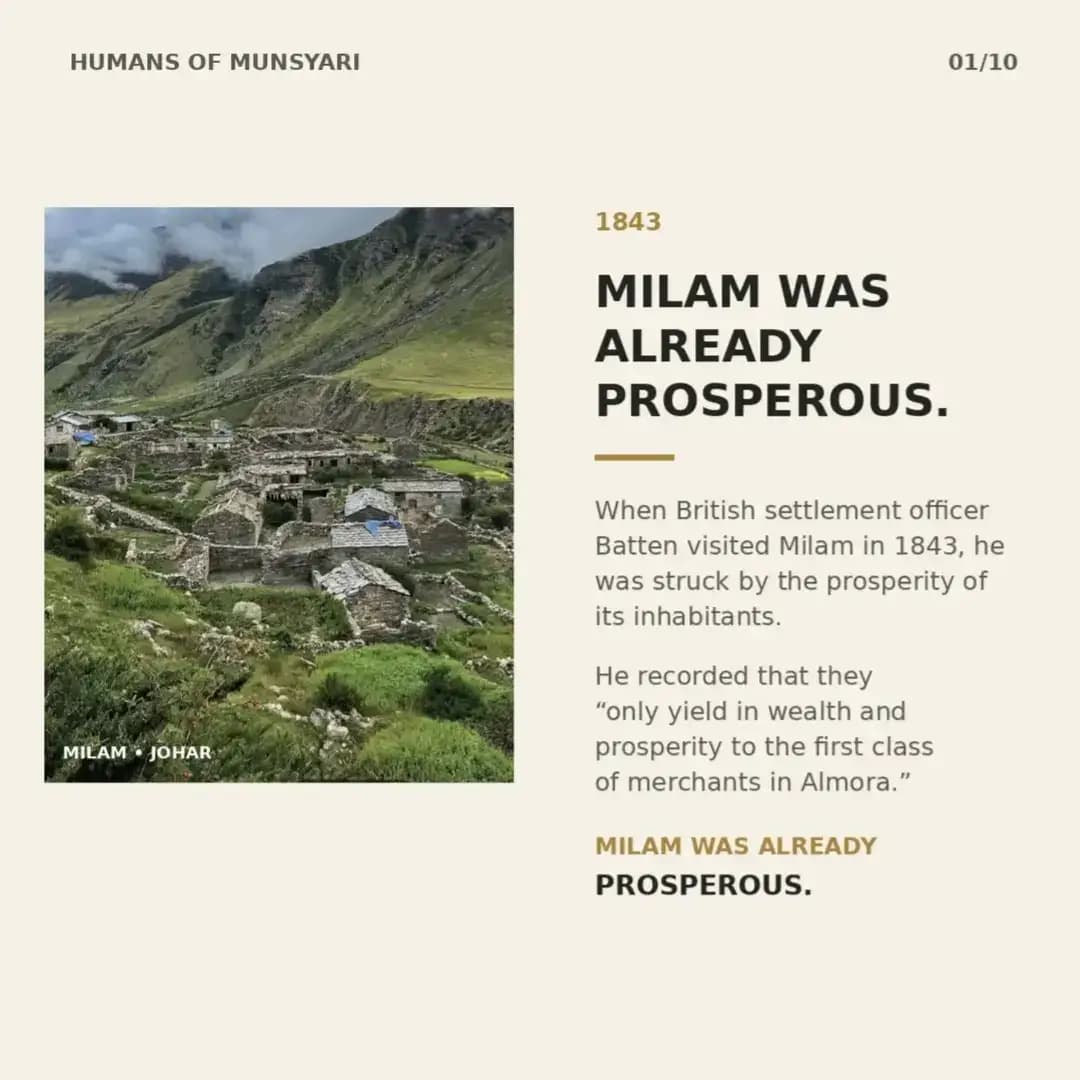
In the 19th and early 20th centuries, Milam was a prosperous Johari settlement and an important centre of trade with Tibet. Its traders crossed some of the highest passes of the Himalayas, carrying goods between Kumaon and Tibet.
In 1843, British settlement officer Batten described the inhabitants of Milam as second only to the first-class merchants of Almora in wealth and prosperity.
By 1900, the village had a recorded population of 1,733.
Then the world that sustained Milam began to disappear.
The closing of the India–Tibet trade routes, followed by the events of 1962, transformed the valley forever.
What remains today are stone walls, empty houses and paths slowly returning to the landscape.
But Milam was once much more than ruins.
It was a trading world. And a way of life.
This is the story of the village that was Milam.
#Milam
#Munsyari
#tibet
A NOTE ON THE PHOTOS 📷
These photographs were collected from various sources, including Instagram, where photographer credits weren’t always available.
If you know the original photographer of any of these images, please DM us. We’d be happy to credit and tag them. 🙏
Jakhnidhar, Tehri Garhwal | Oct 14, 2026